Glossary: Terms, Definitions, & Frequently Asked Questions
This glossary is designed for EHS managers, facility managers, and compliance professionals responsible for managing regulated waste under U.S. federal environmental regulations. State requirements may be more stringent.
A
Accumulation Start Date
The accumulation start date is the date hazardous waste first begins accumulating in a container or tank. This date determines how long waste can legally remain on-site before shipment under RCRA generator requirements.
Missing or incorrect accumulation dates are among the most common inspection findings—especially during facility cleanouts, turnarounds, or shutdowns—because inspectors often compare container dates with shipping records and manifests to verify compliance.
Accumulation Time Limits
Accumulation time limits are the maximum number of days hazardous waste can be stored on-site before shipment, based on generator status. Large Quantity Generators have 90 days, Small Quantity Generators have 180 days (or 270 days if the disposal facility is more than 200 miles away), and Very Small Quantity Generators have no federal time limit but must comply with quantity restrictions.
Exceeding accumulation time limits without a RCRA storage permit is a serious violation that can result in enforcement actions, facility shutdown orders, and penalties exceeding $59,973 per day under the 2025 EPA penalty schedule. Facilities should monitor accumulation start dates closely and schedule pickups well before deadlines to avoid emergency service charges.
Asbestos
Asbestos is a regulated mineral fiber historically used for insulation, fireproofing, and durability in industrial and commercial buildings. It is commonly found in pipe insulation, boilers, floor tiles, roofing, fireproofing, gaskets, and older equipment. While most new uses are prohibited, asbestos remains a major compliance issue during maintenance, renovation, and demolition.
For EHS and facility managers, asbestos matters because disturbing asbestos-containing materials can release airborne fibers, trigger OSHA and Clean Air Act requirements, and shut down projects. Many states enforce stricter rules than the federal baseline, especially around notification and disposal.
Common Questions
B
Biennial Hazardous Waste Report
The Biennial Hazardous Waste Report is a federally required report submitted every even-numbered year by facilities that operated as Large Quantity Generators (LQGs) at any point during the reporting year. It summarizes hazardous waste generation, management methods, and disposal activities.
EPA inspectors frequently request this report to verify generator status and cross-check manifest records. Many states impose additional reporting requirements beyond the federal baseline. The next federal deadline is
March 1, 2026, covering
calendar year 2025 for sites that operated as an
LQG at any time during 2025.
Bulk Waste
Bulk waste refers to large-volume waste streams such as sludges, contaminated soil, tank bottoms, debris, or liquids that cannot be easily containerized in standard drums. Bulk waste typically requires specialized equipment like vacuum trucks, roll-off containers, or tanker transport.
Bulk waste often drives higher disposal costs due to transportation complexity, disposal facility acceptance requirements, and waste profiling needs. Proper characterization and correct documentation are critical to avoid rejected shipments and compliance issues.
C
Certificate of Disposal (COD)
A Certificate of Disposal is a document issued by a Treatment, Storage, and Disposal Facility (TSDF) confirming that waste was received and processed for final treatment or disposal. While not explicitly required under federal RCRA rules, CODs are widely considered best practice and are commonly requested during audits, inspections, and due diligence reviews.
CODs help demonstrate cradle-to-grave compliance and provide additional verification beyond the manifest system. Facilities typically retain CODs with manifests for at least three years, and often longer for liability protection.
Common Questions
- Why does a Certificate of Disposal matter?
- Why do I need a Certificate of Disposal?
- What information is included on a Certificate of Disposal?
- How long should I keep a Certificate of Disposal?
- What is the difference between a Certificate of Disposal and a Manifest?
- How do I verify a Certificate of Disposal is Legitimate?
- More FAQs about a Certificate of Disposal.
Certificate of Treatment
A Certificate of Treatment confirms that waste was treated to meet EPA Land Disposal Restrictions (LDRs) prior to final disposal. LDRs prohibit certain hazardous wastes from being land-disposed unless they meet specific treatment standards.
This documentation is especially important for restricted waste codes (including certain solvents and metal-bearing wastes) that may require thermal treatment, stabilization, or other processes prior to landfill disposal. Facilities shipping restricted wastes should ensure treatment requirements are addressed and retain certification records.
Central Accumulation Area (CAA)
A Central Accumulation Area is a designated on-site location where hazardous waste is temporarily stored prior to off-site shipment. CAAs are subject to requirements such as container labeling, inspections, emergency preparedness, and accumulation time limits based on generator status. Secondary containment is often required depending on the waste and site conditions, and many states apply stricter requirements.
CAAs are heavily scrutinized during inspections. Issues like missing labels, incomplete inspection logs, open containers, or exceeded time limits are common enforcement triggers.
Contaminated Soil
Contaminated soil is soil impacted by hazardous substances, petroleum products, heavy metals, or other regulated materials. Depending on contamination levels and applicable rules, soil may require testing, profiling, and disposal as hazardous waste or as regulated industrial waste.
Soil from spill cleanup, UST removals, remediation projects, or demolition activities often requires characterization testing (e.g., TCLP and other analyses) to determine proper classification and disposal options. Improper classification can lead to rejected loads and compliance issues.
Cradle-to-Grave
Cradle-to-grave refers to RCRA's liability framework, requiring generators to track and remain responsible for hazardous waste from the point of generation through transportation to final treatment or disposal. This accountability is established through the manifest system, which documents each transfer of custody and confirms waste reached its designated facility.
Under cradle-to-grave liability, generators can face enforcement actions and cleanup costs even years after waste left their facility if disposal was improper or conducted at unpermitted facilities. Maintaining complete manifests, Certificates of Disposal, and TSDF verification protects against long-term liability exposure.
D
Disposal (Hazardous Waste Disposal)
Disposal refers to the final treatment or placement of hazardous waste at an authorized facility. Disposal methods may include landfilling (after treatment if required), incineration, fuel blending, chemical treatment, or stabilization.
Under RCRA’s cradle-to-grave liability framework, generators remain responsible for their hazardous waste even after it leaves the facility. Selecting appropriate vendors and retaining complete documentation is essential for long-term liability protection.
Drums
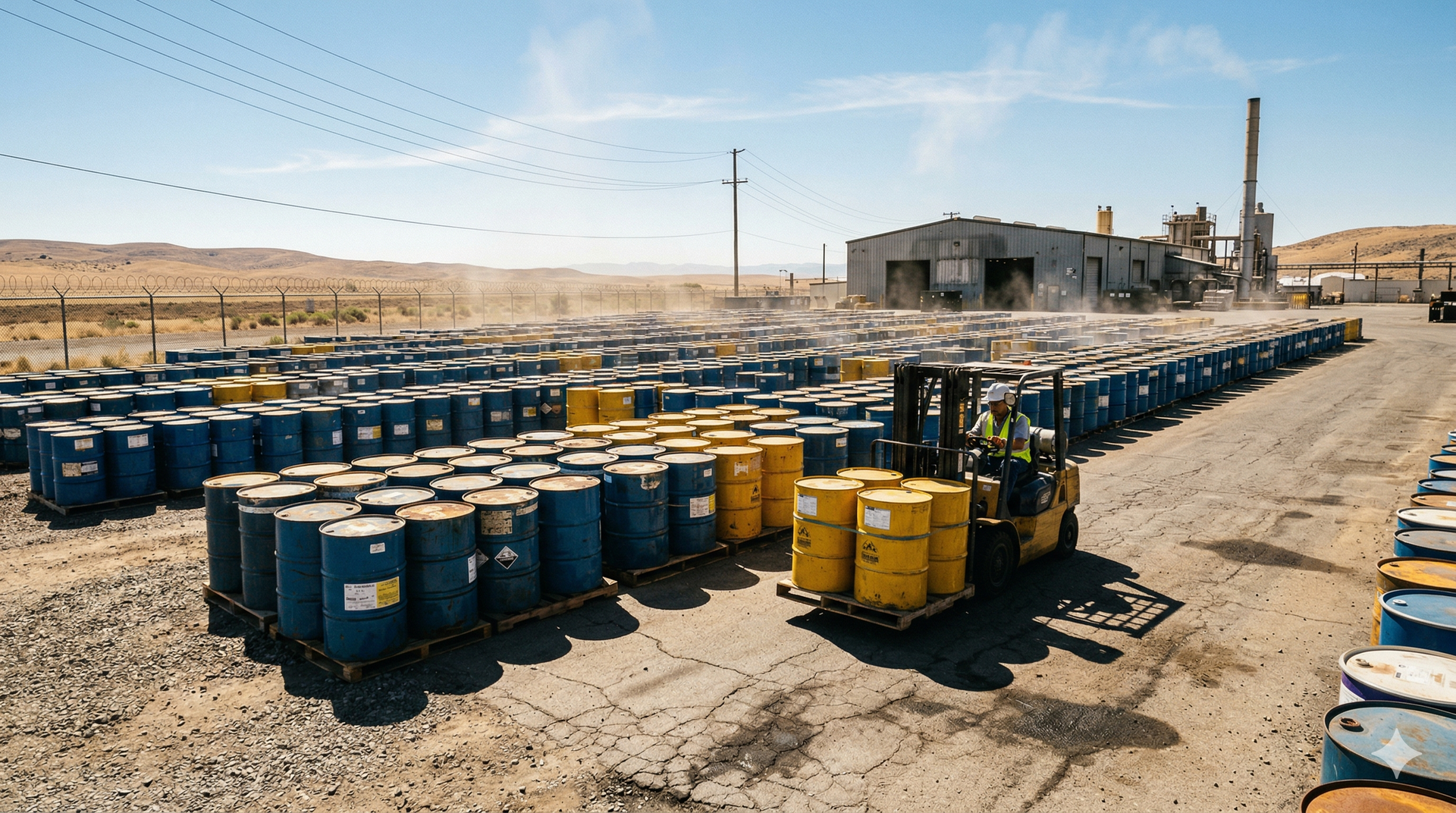
Drums are the most common containers for hazardous and industrial waste shipments, typically 55-gallon steel or poly drums. Drums must meet DOT and EPA expectations for compatibility, structural integrity, proper labeling, and secure closures.
Damaged, improperly labeled, or incompatible drums are a frequent cause of shipment rejections, DOT issues, and project delays. Facilities should inspect containers before use and maintain drum condition throughout storage.
E
EPA ID Number
An EPA ID Number is a unique 12-character identifier assigned to hazardous waste generators, transporters, and TSDFs. Generators shipping hazardous waste off-site typically must obtain an EPA ID Number through their state environmental agency before the first shipment.
The EPA ID Number appears on manifests and e-Manifest submissions, linking shipments to a specific site. Using the wrong ID—or shipping when an ID is required but not obtained—can create serious compliance problems.
e-Manifest
e-Manifest is EPA’s national electronic hazardous waste manifest system used to track hazardous waste shipments from generation through transportation to final receiving facilities. Most hazardous waste generators must use e-Manifest or ensure paper manifest data is submitted electronically.
Errors in e-Manifest entries—incorrect waste codes, transporter details, or EPA ID Numbers—can delay acceptance at receiving facilities and create compliance issues. Facilities should verify manifest accuracy before signing and retain records for at least three years.
Common Questions
F
Facility Cleanout
A facility cleanout involves removing accumulated, legacy, abandoned, or unknown waste—often during shutdowns, ownership changes, decommissioning projects, or EHS compliance initiatives.
Cleanouts frequently trigger generator status changes due to volume spikes, require extensive profiling or testing, and must be planned to avoid exceeding on-site accumulation limits. Unknown or poorly documented wastes are a common source of risk and cost escalation.
Flammable Waste
Flammable waste includes liquids with a flash point below 140°F (60°C) and certain solids capable of causing fire through friction, absorption of moisture, or spontaneous chemical changes. Many flammable wastes are managed as D001 hazardous waste under RCRA and typically ship under DOT flammable liquid requirements.
Common examples include spent solvents (acetone, toluene, xylene), paint thinners, alcohol-based solutions, and certain oils. These wastes must be stored in compatible containers, segregated from incompatibles, and shipped with proper documentation.
Fuel Blending
Fuel blending is a waste treatment method where compatible combustible wastes (spent solvents, waste oils, paint waste) are blended with fuel used in cement kilns, industrial boilers, or other energy recovery facilities. Fuel blending can reduce disposal costs compared to incineration or landfill disposal while providing energy value.
Acceptance for fuel blending requires detailed waste characterization including BTU analysis, halogen content, heavy metals testing, and TSDF approval. Not all wastes qualify, and generators must verify compatibility with specific fuel blending facilities before selecting this disposal option.
G
Generator Status
Generator status classifies facilities based on monthly hazardous waste generation volumes: VSQG (≤100 kg/month), SQG (100–1,000 kg/month), or LQG (≥1,000 kg/month). Generator status determines accumulation time limits, training requirements, contingency planning, and reporting obligations.
Facilities must track hazardous waste generated each calendar month and adjust compliance when the status changes. Misclassifying status or failing to implement the correct requirements is a common inspection finding.
EPA's Episodic Generation rule allows facilities to temporarily exceed normal generator status during planned or unplanned events (cleanouts, equipment failures, production surges) without permanently changing status, provided proper notification and management procedures are followed. Approaching accumulation time limits often requires expedited pickups at premium pricing to avoid violations.
Generator Knowledge
Generator knowledge refers to using process knowledge, Safety Data Sheets (SDS), and operational records to characterize waste instead of laboratory testing. EPA allows generator knowledge for waste determinations when documentation is thorough, defensible, and based on reliable information about raw materials and processes.
Poor or undocumented generator knowledge is a frequent inspection issue. Facilities should maintain written records supporting determinations and be prepared to perform analytical testing when process knowledge is not sufficient.
H
Hazardous Waste
Hazardous waste is waste that exhibits one or more hazardous characteristics (ignitability, corrosivity, reactivity, toxicity) or is listed by EPA as hazardous under RCRA. Hazardous waste requires proper labeling, trained handling, time-limited storage, manifesting (when shipped off-site), and disposal at permitted facilities.
Misclassifying hazardous waste as non-hazardous—or vice versa—can result in rejected loads, compliance violations, and long-term liability exposure.
Hazardous Waste Manifest
A hazardous waste manifest (EPA Form 8700-22) is the shipping document that tracks hazardous waste from the generator through transportation to the receiving TSDF. Manifests include waste descriptions, EPA waste codes, quantities, generator and transporter information, and signed certifications.
Generators must retain signed manifests for at least three years and follow up when signed copies are not returned in expected timeframes. Missing or incomplete manifests are among the most common inspection findings.
Exception reporting is required when signed manifests are not received within specified timeframes: Large Quantity Generators must initiate follow-up by day 45 and submit exception reports by day 60, while Small Quantity Generators submit exception reports by day 60.
Hazardous Waste Training
RCRA requires personnel involved in hazardous waste management to receive training appropriate to their job functions. Training should cover waste handling procedures, emergency response roles, container management, and compliance requirements. Training frequency and documentation requirements vary by generator status.
Inspectors routinely review training records. Missing or outdated documentation is a common violation.
Hot Load
A hot load is a waste shipment rejected by the receiving facility for inaccurate profiling, undeclared constituents, or waste that does not match the approved profile. Hot loads result in additional transportation costs to return waste to the generator, re-profiling fees, delays, and potential compliance violations.
Hot loads are prevented through accurate waste characterization, comprehensive analytical testing, detailed waste profiles, and transparent communication with TSDFs prior to shipment. Facilities that experience hot loads often face increased scrutiny of future shipments and may lose TSDF acceptance privileges.
I
Incineration
Incineration is the controlled combustion of hazardous waste at high temperatures to destroy organic compounds and reduce waste volume. Incineration may be required for certain wastes or selected to reduce long-term liability risk.
Only appropriately permitted facilities can accept hazardous waste for thermal treatment, and incineration often has different approval and profiling requirements than land disposal.
Incompatible Waste
Incompatible wastes are materials that can react dangerously if stored or mixed together, potentially causing fires, explosions, toxic gas generation, or violent reactions. Common incompatibilities include acids with bases, oxidizers with flammables, and water-reactive materials with aqueous wastes.
RCRA and OSHA require segregation and controls to prevent accidental mixing. Incompatible storage issues are treated seriously during inspections because they present immediate safety risks.
L
Lab Pack Waste
Lab pack waste refers to small containers of chemicals and laboratory materials packed together in an overpack drum with absorbent packing material. Lab packing is commonly used for expired chemicals, small-quantity waste streams, and laboratory or facility cleanouts.
Lab packs can reduce handling complexity, but incompatible materials cannot be packed together, and proper profiling is required for each component.
Land Disposal Restrictions (LDRs)
Land Disposal Restrictions (LDRs) under 40 CFR Part 268 prohibit land disposal of certain hazardous wastes unless they first meet specific treatment standards. LDRs require treatment to destroy, remove, or immobilize hazardous constituents before landfill disposal, preventing groundwater contamination from leaching waste.
Treatment standards vary by waste code and may require incineration, stabilization, chemical destruction, or other methods. Generators shipping LDR-restricted waste must provide notifications and certifications to receiving facilities that document that the waste meets treatment standards or identifies the required treatment. LDR compliance is one of the most common causes of shipment delays, rejected loads, and increased disposal costs.
M
Manifest (Hazardous Waste Manifest)
A hazardous waste manifest (EPA Form 8700-22) is the official shipping document used to track hazardous waste from the generator, through transportation, to the receiving Treatment, Storage, and Disposal Facility (TSDF). The manifest establishes cradle-to-grave accountability and is one of the most closely reviewed documents during EPA and state inspections.
Generators must ensure manifests are completed accurately, signed by all parties, and retained for at least three years. Missing, incomplete, or unreturned manifests are among the most common enforcement findings.
Mixed Waste
Mixed waste typically refers to waste regulated under multiple programs—most commonly radioactive + hazardous waste, or waste regulated under RCRA plus another federal program (such as TSCA for PCBs). Mixed waste requires specialized handling, documentation, and acceptance by appropriately permitted facilities, and misclassification can cause rejected shipments, cost escalation, and compliance violations.
Because mixed waste often involves overlapping rules and limited disposal options, accurate profiling and clear documentation are critical before shipping. Many states also impose requirements that are more stringent than federal baselines.
Media (Contaminated Media)
Contaminated media refers to environmental materials—soil, water, debris, absorbents, PPE, wipes, or filters—that become contaminated during operations, spill cleanup, or maintenance activities.
Media disposal is often more complex than containerized waste because characterization can be difficult, volumes can be unpredictable, and cleanup standards may apply. Contaminated media from spill response may also trigger CERCLA reporting if hazardous substance quantities exceed Reportable Quantities.
N
Non-Hazardous Industrial Waste
Non-hazardous industrial waste includes regulated and unregulated wastes that do not meet the federal definition of hazardous waste but still require proper handling, transportation, and disposal. Common examples include industrial debris, wastewater treatment residuals, non-hazardous sludges, contaminated packaging, and process byproducts.
For facility managers, non-hazardous classification does not mean unregulated. Misclassification can result in higher disposal costs, rejected shipments at receiving facilities, or enforcement violations if waste is later determined to be hazardous through testing or inspection review. Many states enforce characterization, manifesting, and disposal requirements that are more stringent than federal baselines.
NOV (Notice of Violation)
A Notice of Violation is a formal enforcement document issued by EPA or state environmental agencies notifying a facility of regulatory violations. NOVs identify specific violations, cite applicable regulations, and typically require corrective action within specified timeframes. Failure to respond to NOVs can result in escalated enforcement including administrative orders, civil penalties, or referral for criminal prosecution.
Common violations triggering NOVs include exceeding accumulation time limits, missing or incomplete manifests, improper waste determinations, inadequate employee training, and operating without required permits. Facilities receiving NOVs should respond immediately with corrective action plans, compliance documentation, and consultation with environmental professionals.
O
OSHA (Occupational Safety and Health Administration)
OSHA regulates worker safety during hazardous materials handling, waste operations, emergency response, and remediation activities. OSHA standards frequently overlap with EPA environmental requirements, particularly in areas such as employee training, personal protective equipment (PPE), respiratory protection, and exposure monitoring.
EHS managers must ensure that all waste handling operations—including drum staging, tank cleaning, spill response, and confined space entry—comply with both OSHA worker safety requirements and EPA environmental regulations. OSHA HAZWOPER training (29 CFR 1910.120) is required for personnel involved in hazardous waste operations and emergency response.
Oily Waste
Oily waste includes materials contaminated with petroleum products, such as absorbents, sludges, rags, filters, wastewater treatment residuals, and tank bottoms. Depending on composition and contamination levels, oily waste may be regulated under RCRA hazardous waste rules, EPA used oil management standards, or state-specific industrial waste programs.
Classification depends on ignitability testing, TCLP analysis for heavy metals, and total petroleum hydrocarbon (TPH) levels. Improper handling or storage of oily waste can trigger both environmental violations and fire-safety concerns under OSHA and local fire codes.
P
PCBs (Polychlorinated Biphenyls)
PCBs are toxic synthetic chemicals historically used in electrical transformers, hydraulic systems, capacitors, fluorescent light ballasts, and building materials including caulk and floor finish. While PCB manufacturing was banned in 1979, PCBs remain a major compliance issue in older industrial facilities, utilities, and commercial buildings.
PCB waste is regulated under the Toxic Substances Control Act (TSCA), not RCRA, and is subject to separate handling, labeling, storage time limits, and disposal requirements. PCB concentrations ≥50 ppm require disposal at EPA-approved TSCA incinerators or chemical waste landfills. Violations of TSCA PCB regulations can result in penalties up to $49,923 per violation per day under the 2025 EPA penalty schedule.
PFAS (Per- and Polyfluoroalkyl Substances)
PFAS are a large group of synthetic chemicals used for their resistance to heat, water, grease, and chemicals. They are commonly found in aqueous film-forming foam (AFFF) used for firefighting, industrial coatings, electroplating operations, wastewater treatment residuals, and biosolids.
For industrial facilities, PFAS may be present in firefighting foam residues, metal-finishing wastewater, landfill leachate, and surface coatings. Federal PFAS regulations are evolving rapidly—effective April 19, 2024, certain PFAS are designated as CERCLA hazardous substances with a 1-pound Reportable Quantity, and October 31, 2026 marks the deadline for TSCA PFAS inventory reporting. Many states already enforce PFAS standards that are more stringent than federal requirements.
Pond and Lagoon Cleanout
Pond and lagoon cleanouts involve removing accumulated sludge, sediment, and residual liquids from industrial wastewater treatment ponds, cooling lagoons, or stormwater retention basins. Cleanouts are typically required for capacity restoration, regulatory compliance, facility decommissioning, or ownership transfers.
Materials removed during cleanouts often require waste characterization testing to determine proper disposal classification, which may range from non-hazardous industrial waste to RCRA hazardous waste depending on process history and contamination levels. Cleanout projects frequently trigger generator status changes and must be carefully planned to avoid exceeding on-site accumulation time limits.
Profile (Waste Profile)
A waste profile is a detailed technical document that characterizes the physical, chemical, and regulatory properties of a specific waste stream. Waste profiles include information such as waste description, generation process, hazardous waste codes (if applicable), analytical test results, flashpoint, pH, and special handling requirements.
Treatment, Storage, and Disposal Facilities (TSDFs) rely on waste profiles to determine acceptance criteria, treatment methods, pricing, and regulatory compliance. Profiles must be submitted and approved before waste shipments can occur. Incomplete, inaccurate, or outdated waste profiles are a leading cause of shipment delays, rejected loads, and increased disposal costs.
R
RCRA (Resource Conservation and Recovery Act)
RCRA is the primary federal law governing the generation, storage, transportation, treatment, and disposal of hazardous waste in the United States. It establishes generator categories, accumulation time limits, training requirements, manifesting obligations, and standards for permitted treatment and disposal facilities.
For EHS and facility managers, RCRA compliance is the foundation of hazardous waste management. Most EPA inspections at industrial facilities focus on RCRA requirements, and violations can result in significant penalties and corrective action obligations.
Recycling (Hazardous Waste Recycling)
Hazardous waste recycling involves recovering materials or energy value from waste through processes such as solvent reclamation, oil re-refining, metal recovery, or fuel blending. Recycling can reduce disposal costs and environmental impact compared to incineration or landfill disposal, but still requires RCRA compliance, including manifesting, facility permits, and proper documentation.
Common recyclable hazardous wastes include spent solvents (distillation and reuse), waste oils (re-refining into lubricants), metal-bearing wastes (recovery of copper, zinc, and precious metals), and batteries (lead and lithium recovery). Not all waste qualifies for recycling, and generators must verify that receiving facilities are properly permitted and that recycling results in legitimate material recovery rather than sham recycling.
Remediation
Remediation involves the investigation, cleanup, and restoration of contaminated soil, groundwater, structures, or surfaces to meet regulatory cleanup standards or risk-based closure criteria. Remediation may be required due to historical contamination, spills, leaking underground storage tanks (USTs), or enforcement actions under CERCLA, RCRA Corrective Action, or state programs.
Facility managers commonly encounter remediation during property transactions (Phase II Environmental Site Assessments), redevelopment projects, facility expansions, or voluntary cleanup programs. Remediation scope, methods, and cleanup standards are typically determined through regulatory consultation and site-specific risk assessments.
Reportable Quantity (RQ)
A Reportable Quantity is the threshold amount of a CERCLA hazardous substance that triggers mandatory spill or release reporting to the National Response Center (NRC) and other federal, state, and local authorities. RQs range from 1 pound to 5,000 pounds depending on the substance.
Facilities must
immediately report releases that equal or exceed the RQ upon discovery, even if the release is contained on-site. As of April 19, 2024, certain PFAS compounds are designated as CERCLA hazardous substances with a 1-pound RQ, significantly lowering reporting thresholds for facilities using AFFF or handling PFAS-containing materials.
S
Satellite Accumulation Area (SAA)
A Satellite Accumulation Area allows hazardous waste to be collected at or near the point of generation before transfer to a Central Accumulation Area (CAA). Generators may accumulate up to 55 gallons of hazardous waste or 1 quart of acutely hazardous waste per satellite location without starting the accumulation clock.
Satellite accumulation containers must be marked with the words “Hazardous Waste” and the accumulation start date once the container is full. Containers must remain closed except when adding or removing waste and be compatible with the waste stored. When quantity limits are reached, waste must be transferred to the CAA within three days.
Improper satellite accumulation management is one of the most frequently cited violations during EPA and state inspections.
Small Quantity Generator (SQG)
A Small Quantity Generator is a facility that generates between 100 and 1,000 kilograms of hazardous waste per month. SQGs are subject to specific accumulation limits, training requirements, emergency preparedness standards, and manifesting obligations under RCRA.
Facilities may move in and out of SQG status based on monthly generation, particularly during cleanouts or maintenance projects.
Sludge
Sludge is a semi-solid waste generated from wastewater treatment, industrial manufacturing, tank cleaning, or remediation activities. Sludge classification depends on analytical testing and process history.
Sludge may be hazardous or non-hazardous depending on TCLP, ignitability, corrosivity, and reactivity results. Improper sludge characterization can result in disposal facility rejection, higher costs, and regulatory violations.
Stormwater
Stormwater is precipitation runoff that may contact industrial materials, waste storage areas, or process equipment. Industrial stormwater discharges are regulated under the Clean Water Act through NPDES permits.
Facilities must implement Stormwater Pollution Prevention Plans (SWPPPs) where required. Improper waste storage can lead to stormwater violations independent of hazardous waste compliance.
T
Tank Cleaning
Tank cleaning involves removing residues, sludges, and liquids from industrial tanks, vessels, or sumps during maintenance, product changeover, or decommissioning. Materials removed during tank cleaning must be characterized for proper disposal.
Tank cleaning projects frequently generate hazardous waste and can trigger generator status changes if not properly planned.
Treatment
Treatment refers to processes that change the physical, chemical, or biological characteristics of hazardous waste to reduce volume, toxicity, or mobility. Treatment may occur on-site or off-site at permitted facilities.
On-site hazardous waste treatment generally requires an EPA permit unless a specific exemption applies. Unauthorized treatment can result in significant penalties.
Transportation (Hazardous Waste Transportation)
Hazardous waste transportation involves moving waste from generators to permitted facilities and is regulated under both RCRA and DOT Hazardous Materials Regulations.
Generators are responsible for proper packaging, labeling, and documentation. Errors can result in shipment refusal, enforcement action, and project delays.
TSDF (Treatment, Storage, and Disposal Facility)
A TSDF is a facility permitted to treat, store, or dispose of hazardous waste under RCRA. TSDFs must meet extensive design, operating, monitoring, and reporting requirements.
Generators remain responsible for selecting permitted TSDFs and retaining disposal documentation.
Turnaround / Shutdown
A turnaround or shutdown is a planned facility outage for maintenance, equipment replacement, inspection, or process upgrades. Turnarounds generate significant waste volumes from equipment cleaning, tank removal, insulation replacement, and maintenance activities, often causing temporary increases in generator status.
Facilities planning turnarounds should coordinate waste disposal in advance to avoid exceeding accumulation time limits, ensure sufficient TSDF capacity, and prevent emergency service charges. Turnaround waste streams often require extensive profiling due to legacy materials, unknown chemicals, or mixed waste from multiple sources.
U
Universal Waste
Universal waste includes widely generated hazardous wastes subject to streamlined management standards, such as batteries, lamps, mercury-containing equipment, certain pesticides, and aerosol cans.
Although requirements are reduced, improper disposal of universal waste remains a common violation reviewed during inspections.
Used Oil
Used oil includes petroleum-based or synthetic oils contaminated through use. Used oil that is
not mixed with hazardous waste and is not otherwise hazardous
may be recycled under EPA standards.
Mixing used oil with hazardous waste can change its classification and significantly increase disposal costs.
V
Very Small Quantity Generator (VSQG)
A VSQG generates 100 kilograms or less of hazardous waste per month and accumulates no more than 1,000 kilograms on-site. VSQGs are subject to reduced federal requirements, though many states impose stricter rules.
Facilities often exceed VSQG thresholds during cleanouts or maintenance projects.
VOC (Volatile Organic Compounds)
Volatile Organic Compounds are carbon-containing chemicals that easily evaporate at room temperature and contribute to air pollution and smog formation. Common VOCs include solvents (toluene, xylene, acetone), paint thinners, degreasers, and petroleum products. VOC-containing wastes are subject to air quality regulations, storage requirements, and specific disposal methods.
Facilities that generate VOC waste must manage containers to minimize air emissions (keep lids closed and use proper venting), comply with air permits, if applicable, and ensure disposal methods meet both RCRA hazardous waste requirements and Clean Air Act standards. VOC content affects waste classification, transportation requirements, and treatment options.
W
Waste Audit
A waste audit is a systematic evaluation of facility waste streams, generation sources, handling practices, and disposal methods to identify compliance gaps, cost-reduction opportunities, and waste-minimization strategies. Waste audits typically include waste stream characterization, regulatory compliance review, employee training assessment, storage area inspection, and disposal cost analysis.
Facilities conduct waste audits to prepare for regulatory inspections, reduce disposal costs through improved segregation or recycling, verify generator status classifications, correct documentation deficiencies, and support ISO 14001 or sustainability initiatives. Professional waste audits provide independent verification and often identify savings that exceed the audit costs.
Waste Broker
A waste broker is a third-party intermediary who coordinates hazardous waste disposal between generators and Treatment, Storage, and Disposal Facilities (TSDFs). Brokers arrange transportation, negotiate pricing, manage waste profiling, and coordinate regulatory documentation without owning treatment or disposal infrastructure.
Generators using waste brokers remain legally responsible for proper disposal under RCRA's cradle-to-grave liability framework. Facilities should verify that brokers arrange disposal at permitted TSDFs, provide complete manifest documentation, maintain adequate insurance, and conduct proper TSDF due diligence. Broker fees should be transparent, and generators should understand which services are provided directly versus coordinated through third parties.
Waste Characterization
Waste characterization is the process of testing and evaluating waste to determine its physical, chemical, and regulatory properties. Characterization establishes whether waste is hazardous or non-hazardous, identifies applicable EPA waste codes, determines appropriate disposal methods, and ensures acceptance by a Treatment, Storage, and Disposal Facility (TSDF).
Characterization methods include laboratory testing (TCLP, ignitability, pH, flash point, metals analysis), documented generator knowledge based on process information and Safety Data Sheets, and field screening for preliminary assessment. Accurate characterization is essential for regulatory compliance, cost control, and the prevention of rejected shipments. Facilities must re-characterize waste when processes change, raw materials are modified, or there is reason to believe waste properties have changed.
Waste Determination
A waste determination is the regulatory evaluation required under 40 CFR 262.11 to determine whether a material is hazardous waste under RCRA. Determinations establish if waste is listed by EPA (F-list, K-list, P-list, U-list) or exhibits hazardous characteristics (ignitability, corrosivity, reactivity, toxicity).
Generators must document waste determinations before managing, storing, or disposing of waste using either laboratory testing or documented generator knowledge. Determinations must be reviewed and updated when processes change or when there is reason to believe waste characteristics may have changed. Improper or undocumented waste determinations are among the most common inspection findings and can result in rejected shipments, compliance violations, and enforcement actions. Documentation must be maintained for at least three years and made available during EPA or state inspections.
Waste Minimization
Waste minimization refers to reducing hazardous waste generation at the source through process modifications, material substitution, equipment improvements, or operational changes. Effective waste minimization reduces disposal costs, decreases regulatory compliance burden, lowers liability exposure, and supports environmental sustainability goals.
Common waste minimization strategies include switching to less hazardous cleaning solvents, implementing closed-loop chemical recovery systems, improving maintenance to prevent spills and leaks, training employees on material handling, and segregating waste streams to maximize recycling. Large Quantity Generators must certify on manifests and Biennial Reports that they have a waste minimization program in place.
Z
Zero Discharge
Zero discharge refers to facilities that do not discharge wastewater to surface waters, publicly owned treatment works (POTWs), or other external water bodies. Zero discharge operations typically manage wastewater through evaporation ponds, on-site treatment and reuse, or complete recycling within closed-loop systems.
While zero-discharge facilities may avoid certain Clean Water Act NPDES permit requirements for wastewater discharge, they remain subject to other environmental regulations, including stormwater management, air emissions controls, and hazardous waste requirements for residuals or treatment byproducts. Facilities claiming zero-discharge status must maintain accurate documentation verifying that no wastewater leaves the site and demonstrate proper management of concentrated waste streams, evaporation pond residuals, or treatment sludge.
Zero discharge claims are subject to verification during inspections, and inaccurate representations can result in enforcement actions for unpermitted discharges or Clean Water Act violations.